How Lebanese artist Rafik El Hariri responds to war through his work
updated on Aug 24, 2026
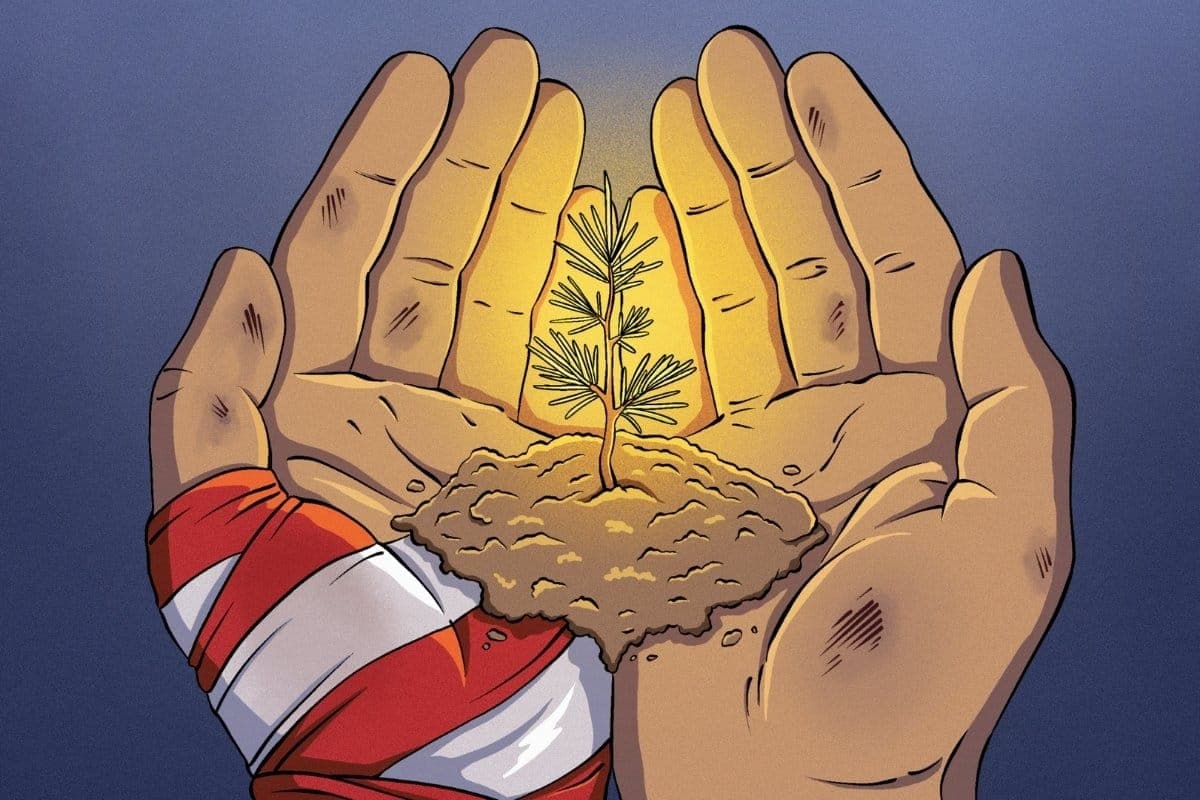
Even in times of immense tragedy, the very human act of making art sustains. In this profile, the Forbes-listed Lebanese artist Rafik El Hariri shares how his work depicting ordinary scenes has become a digital lifeline to his followers
Whenever disaster strikes Lebanon, Rafik El Hariri’s reaction is to draw.
His art offers people something the news cycle (and rage-filled social media feeds) cannot: A breath. Two cups of Lebanese coffee, the words “How are you? I’m trying to be okay.” Two chairs side by side, one saying, “I’m always there for you, thank you for being there.” Simple illustrations, yet the kind that make people stop scrolling and hit share.
Rafik, 32, is a Lebanese digital artist who has come of age watching his country absorb crisis after crisis – the October 2019 uprising that collapsed the Lebanese pound, the Beirut port explosion of August 2020 that killed more than 218 people and left entire neighborhoods in ruins, and Israel’s ongoing war on Lebanon, which began in October 2023 and has killed nearly 4,000 people and displaced more than a million.
“Sometimes, overnight, you feel like the world has turned upside down,” Rafik said softly, the way someone says something they have thought about many times.
“We must take a breath,” said Rafik. “That is the ultimate goal of my art. We are in a digital age, and we are thirsty for rest, for imagination, for dreaming.”
Through his illustrations, Rafik has built an online sanctuary, where art does what politics cannot: heal.
His accolades are many. On Instagram, where he describes himself as a ‘Mental Health Advocate’, he’s amassed over 170,000 followers. In 2021, Forbes Middle East named him to its 30 Under 30 list. And he’s collaborated with Adobe, Apple, Nike, Puma Middle East, the UN, and Médecins Sans Frontières.
A homeland that taught him to see
Rafik’s art is rooted in his hometown. He is from Tripoli, a port city on the Mediterranean that is Lebanon’s second biggest. It is famously known as Al-Fayhaa, meaning ‘the fragrant’, a reference to the scent of orange blossoms that once wafted in from surrounding orchards. Tripoli is layered in history, old souls, and a culture that persists despite decades of economic neglect. It is a place that knows what it means to be looked past.
Rafik said that he grew up learning to see its hidden beauty, and that sensibility became the engine of his entire aesthetic practice. He was a shy child who, in drawing, found an alternative language. Before pencils, there were scissors and magazines. He would cut images and reassemble them into new stories. “I used to draw on my school desk, on any available surface,” he says. “And before drawing, I was also obsessed with making collages, cutting pictures from magazines and then putting them back together to create new stories.”
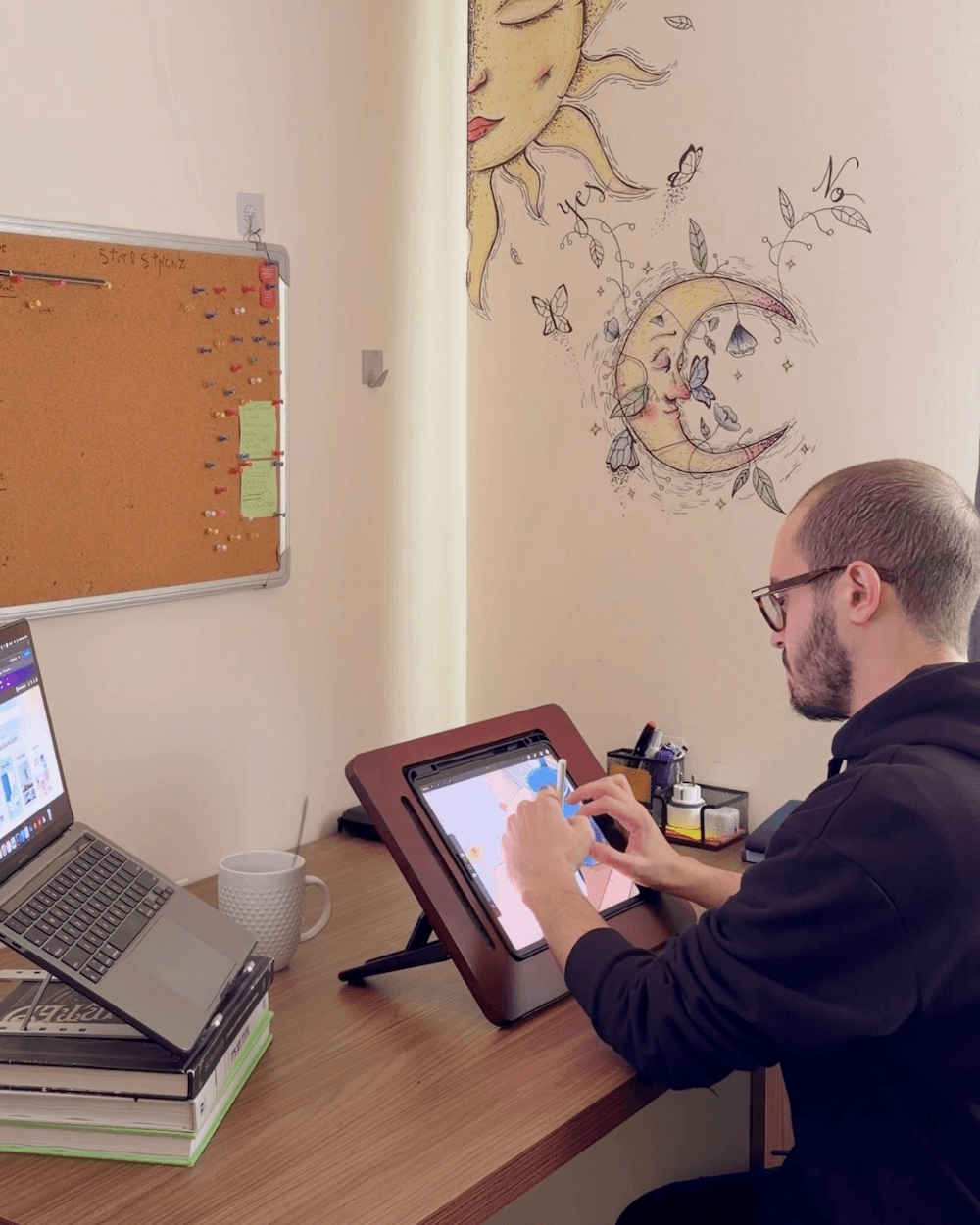
He studied graphic design, partly on his mother’s counsel, his most consistent early advocate. Although his original interest had been clinical psychology, and that curiosity never fully left him.
“My curiosity about the human mind, the impact of childhood and society on a person, all of that stayed present and wove itself into my artistic work later.”
There is an irony in Rafik’s name. He shares it with Lebanon’s most prominent ex-prime minister, who was assassinated in 2005. In a country defined by sectarian allegiances, that coincidence carried real consequences. “My name has two sides, positive and negative,” he said. He faced bullying at school and exclusion in professional settings. But outside Lebanon, none of that followed him. “They didn’t care about my name at all, only the art I offered.”
Art became a language that bypassed every label.
When war entered the work
Rafik’s aesthetic is unmistakable. Soft tones, reduced saturation, a quality that recalls watercolour without being it. His work is technically digital, but he deliberately leaves in imperfections, the rough edges that signal a human hand. His primary influence is René Magritte, whose paintings hold a peculiar calm even as they quietly unseat reality. Rafik carries that into a Lebanese context, where objects defy gravity, hearts float, and smoke rises from teapots and skulls alike.
The objects he returns to are deeply nostalgic. A cassette tape, a straw basket lowered by rope from a balcony (what he calls ‘old times delivery’), a biscuit tin repurposed by mothers into a sewing kit. These consistently receive his highest engagement. “The more the world accelerates,” he said, “the greater our need to hold on to what is human.”
Rafik’s generation has never known Lebanon without crisis, and the ongoing war has forced a reckoning with what art is for. “It affected me very deeply,” he explains. “It wasn’t possible to draw any other idea while this pain was so present.”
He also recognised a responsibility he could not ignore. “I draw because I love drawing and I love speaking through it,” he said. “But there is also a social responsibility. When I am in a country that feels a certain pain, it is not wrong to escape into imagination, but I must also remember that there are people around me waiting for what I offer.”
One illustration from that period became the closest to his heart. Two empty chairs on a balcony, a small table between them. One chair asks the other, “What will happen?” and the other replies, “Whatever God has written.” It reached nearly a million views, finding resonance far beyond Lebanon, in the Gulf and across the Arab world.
Three books, one interior journey
Rafik’s books give his art breathing room to develop longer-form, often deeply personal, ideas. The book Indigo (2018) is Rafik’s account of living with an eating disorder – a subject that is rarely whispered, let alone published. I Found a Heart (2021) is born from the pandemic lockdown and explores isolation, disappointment, and the radical act of sitting quietly with oneself. “During the lockdown, I found myself with a vast space of time,” he said, “and I decided to turn my experiences, thoughts, and fears into a complete work.” It coincided with his Forbes recognition. His third book, 3 AM (2022), captures the unfiltered thoughts that surface just before sleep.
His fourth book, still untitled, will explore shared cultural threads across the Arab world. It’s a natural extension of his core belief: that what connects people is more durable than what divides them, and that naming a shared feeling is itself a form of healing.
When I ask Rafik what homeland means to him, his answer is immediate. “Homeland, for me, is security and the familiar.”
His city, where he chose to stay, appears in his work as a heart-shaped piece of land carrying its landmarks, floating against gravity, beloved even as it resists the weight pressing it down.
“Whatever leads us to live in peace, to love our homeland, and not be forced to leave it, I will support it,” he said. It is, at its heart, a mental health position.
This story is published in collaboration with Egab. Image courtesy of Pedro Safadi.
Find a professional today
Try our guided search tool, we can connect you with over 20,000 professionals.