What can we learn from the ‘overview effect' experienced by astronauts?

updated on Oct 27, 2026
Known intimately only by a handful of people who have been into space, what can the ‘overview effect’ teach us about our planet and the unity we need to save it?
“You don’t see borders, you don’t see religious lines, you don’t see political boundaries. All you see is Earth, and you see that we are way more alike than we are different.” So said Christina Koch, NASA astronaut and Artemis II mission specialist.
In this moving quote, she was reflecting on the ‘overview effect’ – a term coined by space philosopher and author Frank White in 1987 to describe the phenomenon, experienced by astronauts, where seeing Earth from space powerfully shifts the way they think and feel about our planet. In 2016, researchers looking into the overview effect described it as a ‘state of awe with self-transcendent qualities, precipitated by a particularly striking visual stimulus’.
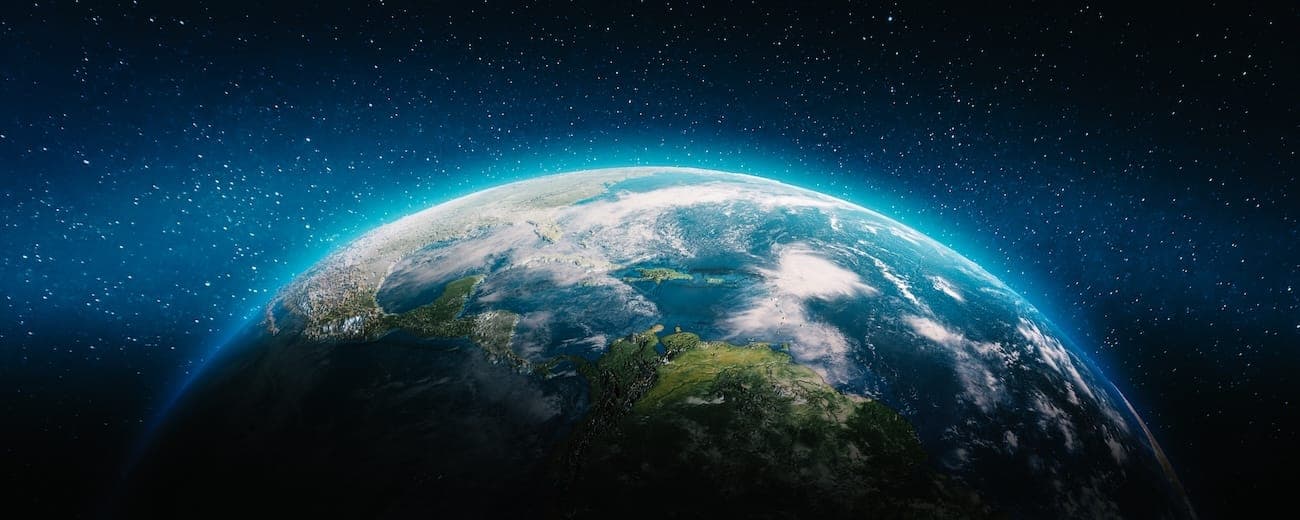
“The overview effect is when you’re looking through the cupola, and you see the Earth as it exists with the whole universe in the background,” said Christina Koch in an article published by NASA. “You see the thin blue line of the atmosphere, and then when you’re on the dark side of the Earth, you actually see this very thin green line that shows you where the atmosphere is. What you realise is every single person that you know is sustained and inside of that green line, and everything else outside of it is completely inhospitable.”
Christina’s reflection on how the overview effect ties into conversations about environmentalism feels like a natural connection, and it’s one that has been present throughout the history of space exploration. In 1950, British astronomer Fred Hoyle predicted in his book The Nature of the Universe: “Once a photograph of the Earth, taken from outside, is available […] a new idea as powerful as any in history will be let loose.”
In 1968, Apollo 8 astronaut William Anders fulfilled this prediction, taking the now legendary photo ‘Earthrise’, the image of the Earth from lunar orbit. The photograph went on to become an icon of the growing environmental movement, and the first Earth Day was then held in 1970.

There’s a reason, beyond the literal, that images of our planet are at the heart of eco movements. They are a prompt to zoom out, to see things from a broader perspective, and to try to tap into something collective – something beyond man-made borders. While those early photographs of the Earth may have offered something akin to the overview effect, our familiarity with such images may make it harder to recreate their original impact. But new technology could help reproduce some of those awe-based emotions – and perhaps their ability to drive positive environmental action.
A 2019 study, published in Frontiers in Digital Humanities, found that a virtual reality experience simulating the effect created ‘minor transformative experiences in some participants’, including their appreciation of beauty and vastness, a realisation of interconnectedness, and the potential intent to change their behaviours. And while the technology here is still in development, other studies are exploring how we can bring such a potentially transformative experience to more people.
Interestingly, such a realisation isn’t just reserved for astronauts. Aquanauts, people who live and work underwater for extended periods, have reported a similar phenomenon – called the ‘underview effect’.
Anthropologist Deana L Weibel coined the term ‘ultraview effect’, describing a response to a clear view of the stars, and the ‘break-off phenomenon’ is experienced by pilots flying at a high altitude.
But for those of us whose feet are set to be firmly planted on the ground for the foreseeable future, purposely seeking out perspectives that could give us a glimpse into these experiences can help us reconnect with a drive to take care of our home planet. Looking at NASA imagery, stargazing on a dark, clear night – as far away from light pollution as you can manage – trying an Earth-viewing experience, or listening to the words of those who have experienced the overview effect for themselves can all offer small ways to capture something of its impact for ourselves.
In times when the weight of the climate crisis can feel crushing, the power of hope, unity, and love is exactly what we need. As NASA astronaut Ron Garan said: “From space, I saw Earth not as a collection of nations, but as a single entity with one destiny.



Find a professional today
Try our guided search tool, we can connect you with over 20,000 professionals.