Forget crystal balls and fortune-telling – today, tarot is being reimagined as a therapeutic tool, helping people process emotions they can’t quite put into words
What comes to mind when you think about ‘tarot’? Historically, it’s been associated with divination, and the word may conjure the image of a mysterious figure in a tent, surrounded by celestial charms, who asks you to cross their palm with silver to hear your fortune. But, in reality, tarot serves many functions – from simple card games to self-reflection, meditation, and journaling, and is used to inspire art, poetry, and music.
For integrative therapist Emma Dellow, it took a while to get acquainted with her first tarot deck. But she finally connected with the tool fully when she became a therapist.
“I found myself being drawn to learning more about symbolism, imagery, archetypes, and a more Jungian way of working with clients,” she says. “At this point, I wondered how I could incorporate my collection of card decks.”
Storytelling through tarot
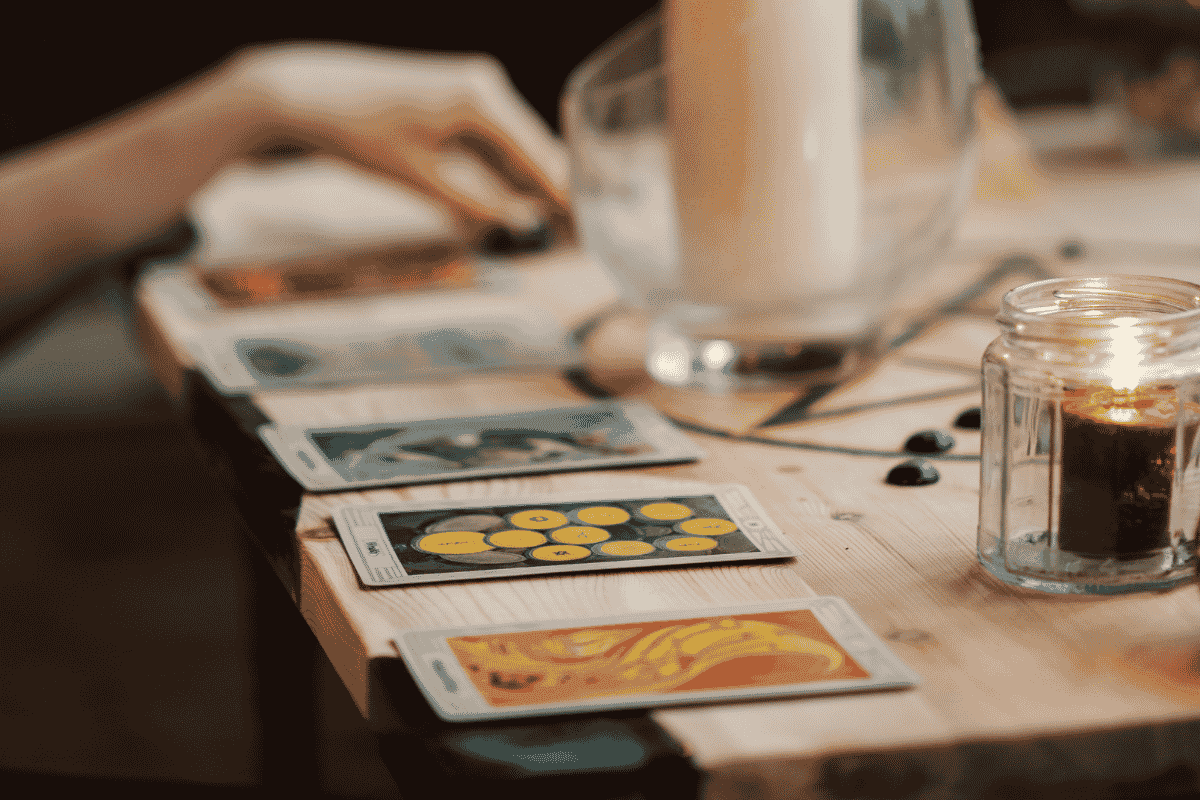
A standard tarot deck is made up of the major and minor arcana. The minor arcana has four suits: cups (emotions, hopes, and dreams), swords (logic and mental health), wands (passions, ambitions, and drivers in life), and pentacles (home, work, and finances). You can use them to explore specific emotions, situations, or goals.
Another way to use the tarot deck is through the major arcana. Emma says: “The major arcana, through the Fool’s Journey, gives us a metaphor our the journey through life.”
The Fool’s Journey through a therapeutic lens
The Fool’s Journey is a symbolic story of the human experience told through the 22 major arcana cards. It goes from humble beginnings (The Fool card), through trials and tribulations (including encounters with The Magician, The High Priestess, The Empress, and many others), to evolution and enlightenment (The World card). Each of the major arcana cards represents a specific step on that journey to wholeness.
In the therapy room, the Fool’s Journey can be used to draw parallels with the journey you are on. Emma does this in therapy sessions by laying out the cards of the major arcana and encouraging the client to think about where along the Fool’s Journey they think they are, thereby opening up a new branch of therapeutic enquiry.
For writer Fiona Fletcher Reid, the therapeutic use of tarot came when her life changed overnight. After realising she was gay and then going through a divorce and moving house, Fiona was doing talking therapy but often felt lost in between sessions. A friend offered to give her a tarot reading, which completely changed her perspective. As she started using tarot on her own, she found it took her out of “catastrophic thinking” and helped her see the good alongside the challenges.
Tarot has also been an important tool for helping her unlearn harmful coping mechanisms and behaviours. “Daily check-ins are great for that, so I randomly pull a card in the morning and then think about it or journal my thoughts.” Fiona also uses tarot cards when she’s struggling with something specific. “For example, when I was dealing with a lot of guilt around my breakup, I was able to use the cards to find ways to demonstrate self-compassion.” Exploring tarot alongside traditional therapy was particularly powerful for Fiona because it allowed her to continue a dialogue with herself in between sessions.
How does tarot actually help in the therapy room?
Emma explains that tarot is particularly helpful if a client is nervous or doesn’t know what to do with their hands; the cards are something to hold and focus on. If a client is open to incorporating tarot into the session, Emma will ask them to look through the deck and “pick out anything they feel drawn to”, which adds an element of curiosity and play to the session.
She explains that the client will often gravitate towards a particular card and start talking about their interpretation of it with great enthusiasm and feeling before realising that, actually, they may be talking about themselves.
Emma says, “I think that when those feelings can be experienced as being ‘outside of the person’ and in front of them on the table, or even on the screen, they can be less overwhelming. Seeing these feelings outside of you can create emotional distance and therefore safety.”
Tarot could be particularly useful in a therapy setting if you struggle to articulate exactly how you’re feeling, or aren’t sure where to start. If there’s a topic you’re avoiding, tarot could be a tool to help you address it through a more conceptual lens at first, giving you an outsider’s perspective, and a chance to observe and better understand your own emotions. In essence, tarot offers us metaphors that can help us discover something new about ourselves.

In a 2022 study on the use of metaphors in cognitive behavioural and psychodynamic therapy, some therapists reported that metaphors were useful for allowing the patient to ‘associate in new ways’. One therapist said the technique emphasised how clients use metaphors to ‘express something that is difficult to put into words’. Another found that “metaphors offer clients a way to express something abstract in a concrete way.” One psychodynamic therapist said: “For patients it can be a helpful tool to view their situation from the outside, to get another point of view. It can stimulate the imagination.”
The growing need for a diverse range of therapies
No two people are the same, so why should therapy look the same for every client?
Some people resonate more with walk-and-talk therapy, allowing them to move their bodies and connect with nature as they share. Art therapy is a great option for some folks, particularly children. And in the last few years, EMDR (eye movement desensitisation and reprocessing) therapy has become a more common tool for processing traumatic experiences where other interventions have not been effective.
Although talking to a therapist can feel uncomfortable at times, you can only get the best out of therapy when you feel a certain level of psychological safety, when all parts of yourself are welcome and received without judgment. That’s why having a range of different therapy options available matters, including therapies with a spiritual element such as tarot.
Using tarot as your own self-reflection tool
Whether or not you consider yourself spiritual, tarot could be a useful therapeutic tool for you.
You could pull a card and journal about what it brings up for you, or ask a question and use a spread as a starting point to think more deeply about how you feel and what you want. Tarot ultimately gives you a point of focus. It gives you an excuse to sit down, slow down, breathe, and think freely.
If you have a tarot deck lying in a drawer somewhere, why not brush off the dust and pull a card? If you’re in therapy and want to explore tarot, why not ask your therapist if you can bring your deck along? The Fool encourages us to take a leap of faith; why shouldn’t you?



Find a professional today
Try our guided search tool, we can connect you with over 20,000 professionals.