Why it’s time to challenge linear thinking when it comes to healing

updated on Sep 3, 2026
Here’s why revisiting familiar challenges can be a sign that you’re growing, not going backwards – and how thinking of healing as a spiral could change the way you see recovery
Saying yes to a weekend hike when you know your body needs rest. Offering to take the grandkids when your brain is already at capacity. Asking your ‘tough love’ friend for advice when you swore you’d spare yourself the tears.
These seemingly small moments can read as colossal failures when you’re trying your best to make progress with your self-growth. And it’s not always the specific situation that causes the most disappointment; it’s the fact that you’re back here, again, repeating patterns that you thought you’d left in the past.
A wise person once said that healing isn’t linear, and most of us who are interested in learning more about our brains and how they work, will nod in agreement with this statement. We know there will be ups and downs – but if healing isn’t a straight line, what shape is it?
Healing as a spiral
I began thinking about healing differently when I started exploring tarot. Alongside symbolism and archetypes, it introduced me to new ways of reflecting on my inner life through both a spiritual and psychological lens.
The thing is, as a culture, we have unprecedented access to so much information about mental health. And alongside the impact on stigma and education, it can sometimes make us hyperaware of our triggers, to the point that we believe that they are proof we are failing.
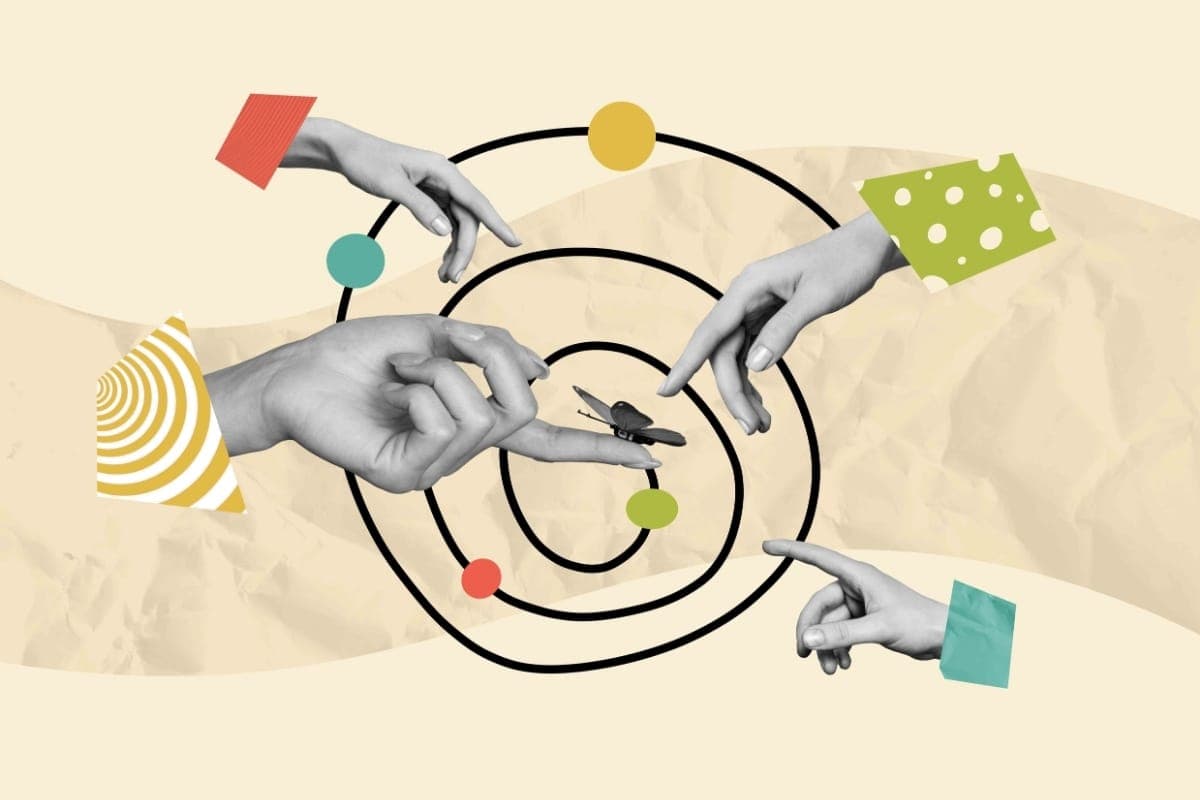
I was feeling this particularly hard one day when a tarot reader friend referred to healing as ‘spiralic’. She explained to me that instead of a typical journey that starts at A and ends at B, healing takes the shape of a spiral – where we move in an upward circling motion.
This hypnotic circular spiralling is our consciousness (or self-awareness) in constant motion, always moving, adapting, and changing as we go. And every time we circle round and return to a repeating pattern? We witness it through new eyes with all the knowledge we’ve gleaned along the way.
But very few of us feel as though we are ascending gracefully upwards in our healing process. Let’s face it, the linear model is baked into our systems and scientific data.
Research into recovery
For decades, therapy research often measured recovery by comparing how someone felt at the start of treatment with how they felt at the end. The messy middle (the weeks spent in bed, out-of-the-blue setbacks, and sudden breakthroughs) were often treated as statistical ‘noise’, while researchers focused on average outcomes across groups.
Yet we can look to nature and see that lasting change is anything but predictable. Forests can regenerate after devastating fires, caterpillars dissolve into gloop before restructuring themselves into butterflies, and broken bones become inflamed before forming new tissue and gradually regaining strength.
It follows suit, then, that psychological healing may follow a similar pattern. Rather than moving steadily upwards, recovery often involves plateaus, setbacks, and moments of rapid change. What once looked like a sign that therapy wasn’t working may, instead, be part of the process of transformation.
Circling the past
Of course, that doesn’t mean that finding yourself circling old issues is necessarily a good thing. But why are they so hard to change? According to therapist and relationship coach Bibi Jamieson, the reason is simple: our brains crave familiarity, even when it causes suffering.
This can leave you stuck between a rock and a hard place – stay safe in a place you don’t want to be, or attempt change and feel afraid. Bibi says it’s important to pause here to distinguish between the two. “Just because something feels uncomfortable doesn’t mean you’re not doing the work,” she says.
“In fact, part of growth is learning to tolerate a new kind of discomfort. Not the discomfort of the old wound, but the discomfort of change.”
For example, perhaps walking down the street where you lived with your ex used to trigger a fight-or-flight response. You thought you’d overcome it, but now, it’s happening again.
“What I encourage clients to do, instead of the perceived setback, is look at what happens next. Do they spiral for three weeks, or three hours? Do they immediately assume they’re not good enough? Or are they able to recognise what’s been activated? Can they be compassionate with themselves? Can they reach out for support? Can they recover more quickly?” says Bibi.
“Sometimes the greatest sign of growth isn’t that the wound disappears. It’s that your relationship to it changes. You no longer collapse into it in the same way. You recognise what’s happening sooner.”

Constant state of change
For me, reframing my healing as a spiral hasn’t just helped me put less pressure on the shape of my journey, but it’s also acted as a reminder that I am an active participant in my recovery.
We change every day; our cells are always regenerating; we are constantly learning new information and new lessons that broaden our perspectives and shift our personal values. We never revisit the same issue as the same person, and that knowledge has given me permission to make different choices.
In this sense, I’ve come to see the spiral symbol as a powerful tool for integrating learned lessons into my identity. This is something that Bibi touches on, too: “I know personally, I tend towards people-pleasing, and so I often describe myself as a recovering people-pleaser. I can now pause before automatically saying yes. The vulnerability may still exist, but self-awareness allows me to put gentle breaks on old patterns. Instead of being driven by them unconsciously, I can make more intentional choices,” she says.
If this all feels like hard work, I think it’s helpful to remember that the ethos of the spiral is reflective of your natural way of being. In the same way that a landscape can go from harsh and barren during the winter season to lush and bountiful in the summer, so too come the highs and lows of healing. While some days may feel a little rough, others will shine bright – making you feel unstoppable.



Find a professional today
Try our guided search tool, we can connect you with over 20,000 professionals.