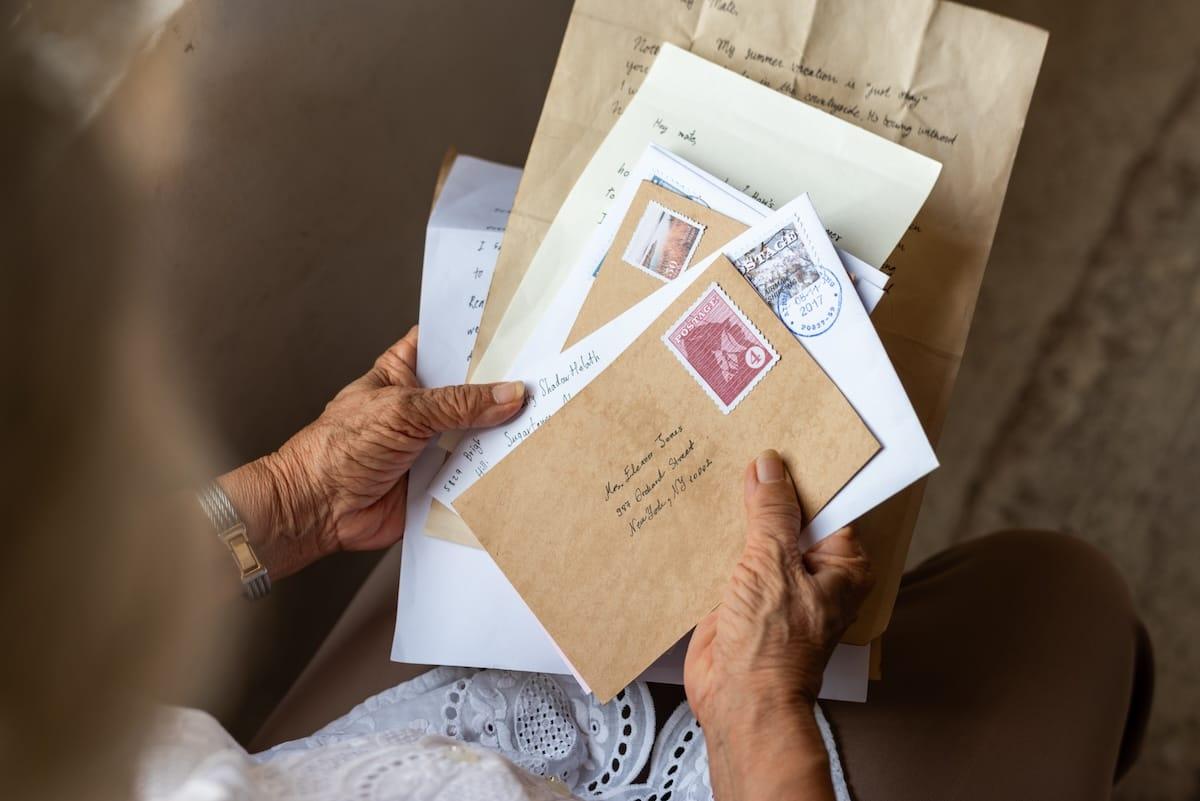
In a digital world, letters hold more meaning than ever before. Here, Kathryn Wheeler sits down for a cross-continental call with US author and ‘letter midwife’, Frish Brandt, to find out more about her work and the five types of letters we should write in a lifetime
Every day, as I sit at my keyboard and write, in front of me stands a special card. It was given to me by a friend who, during what was a hard time for me, found the words I needed to hear, wrote them down, and gave them to me in an envelope.
I find myself feeling emotional as I recount this story to Frish Brandt. An author and ‘letter midwife’, Frish teaches letter writing at Stanford University’s School of Medicine and to individuals and institutions around the world, including museums, universities, hospitals, and caregiving associations.
“I don’t think there’s anything that really replaces the contemporaneous note,” Frish says. “I’m not saying nothing is better, but there’s nothing that replaces it.”
Frish speaks with true feeling about letters. She came to them from working in the arts – something that, at the time, fulfilled all her wishes. But in midlife, she started to feel like there was something even more meaningful out there.
“I read about palliative care and thought: ‘That’s what I really want to be involved in.’ Art is great, but mortality beats all. Eventually, I got a calling, basically: you could help people write letters. And I thought, ‘I could do that. What the hell does that mean?’”
The first letter that Frish ‘midwifed’ was with a young mother whose lungs were failing. “She knew she didn’t have a lot of time,” Frish recalls. “And she knew what she wanted to say: it was about kindness. That was her legacy.”

From that first letter, Frish’s work evolved naturally. From sitting in the front seat with a Lyft driver, writing a letter to his mother in Tunisia, to an incarcerated man writing to his wife he had been estranged from for 24 years. Working one-on-one and also in groups, together with others, the letters are birthed.
“It is not unusual for people to have a little hesitancy,” she shares. “You can sit down to write a letter, and you don’t even have to know who it’s to. Most people will have kick-started their thinking when they reach for the paper, but maybe they’ll just feel kind of hungry and not know what they want to eat.
“My goal was to hold their hand a little bit in the process. When I do it one-to-one, we’re just having a conversation. I’m taking notes, and we’re talking — and then I hear the letter.”
Frish recounts many of her letters in her new book Unfinished Business: How to write the five essential letters of your life. Among touching stories of the letters she has helped write, and the people who inhabit them, Frish shares advice for writing five essential letters. They are: ‘Thank you’, ‘I’m sorry’, ‘I miss you’, ‘I love you’, and ‘Goodbye’. I ask Frish why these five letters?
“There are a number of traditions, whether ethnic, religious, or otherwise, that come back to similar things: thank you, I forgive you, please forgive me, I love you. For people who sit with others close to the end of life, these are the things that come up,” she explains. “When I boiled down the hundreds of letters I’d done, they all came to one of those five things.”
Frish explains that these categories are also very settling. Starting with five genres of letters, we can categorise our experiences and simplify them in a way that may not have felt immediately obvious before. And there’s comfort in that, too. Imagining that, through the vastness of human emotion, most of what we wish to say to each other can be summed up in simple, everyday words.
I can’t help but ask Frish about one particular letter in her book. A woman, Lynn, had been given the news that she had weeks left to live. Having become estranged from her parents, as her illness progressed, she tried to reconnect with them in vain. As a last hope, she reached out to Frish. As they sat down to write, Frish asked: ‘What haven’t you said?’ Lynn thought, and then replied, simply and honestly: “I miss them.” I won’t spoil the rest of the story, but know that it has a happy ending.
“I have goosebumps,” Frish says on our call. “That story was really remarkable. I could feel her hesitancy to send the letter. She had been so burned. I couldn’t figure out what she was delaying about because she really wanted to reach out. The whole experience unfolded like a flower opening up.
“Two death doulas who had worked with Lynn later approached me and said: ‘That letter did something nobody could do.’ She had been living in fear that she would die and it would be left unresolved. It gave her peace.”
For sharing the things that have gone unsaid – the difficult things, and the joyful things, too – letters still have a place in our lives and our hearts. They allow us the time to articulate what’s on our minds, invite the reader to sit with us a while, and show others that, to us, they are more than worth the time spent putting pen to paper. Perhaps they matter even more now than before.
“Don’t we feel good when we’ve put it down on paper?” Frish adds. “Then it exists.”
It is Frish’s hope that her work forms a movement. A force of people who not only write letters to each other, but sit next to others and help them to find the words, too.
“The goal is not the perfect letter; it’s your letter. We live in a world where we’re trying to do it all so right. It doesn’t need to be perfect; it just needs to be yours,” Frish says. “It’s simple; it’s not easy. A letter is the thing you can give that nobody else can.”
As we come to the end of our call, Frish suggests that I reach out to my friend to tell her what her letter meant to me, and to ask what it meant to her, too. I, of course, do as she says. And I am left reflecting on the things that stop us from saying what needs to be said. Perhaps it is fear of being vulnerable, or perhaps it’s the worry of not being able to articulate the complexity of our feelings for one another. Yet, despite this, Frish’s work shows that, so often, the only requirement of our words is that they are true.
“There’s no time like the present,” she says. “And there’s no present like a letter. So why do we wait?”


Find a professional today
Try our guided search tool, we can connect you with over 20,000 professionals.