The wind phones helping people reconnect with lost loved ones
updated on Oct 1, 2026
Things left unsaid, words we’re too scared to voice... What would you say if you had the chance?
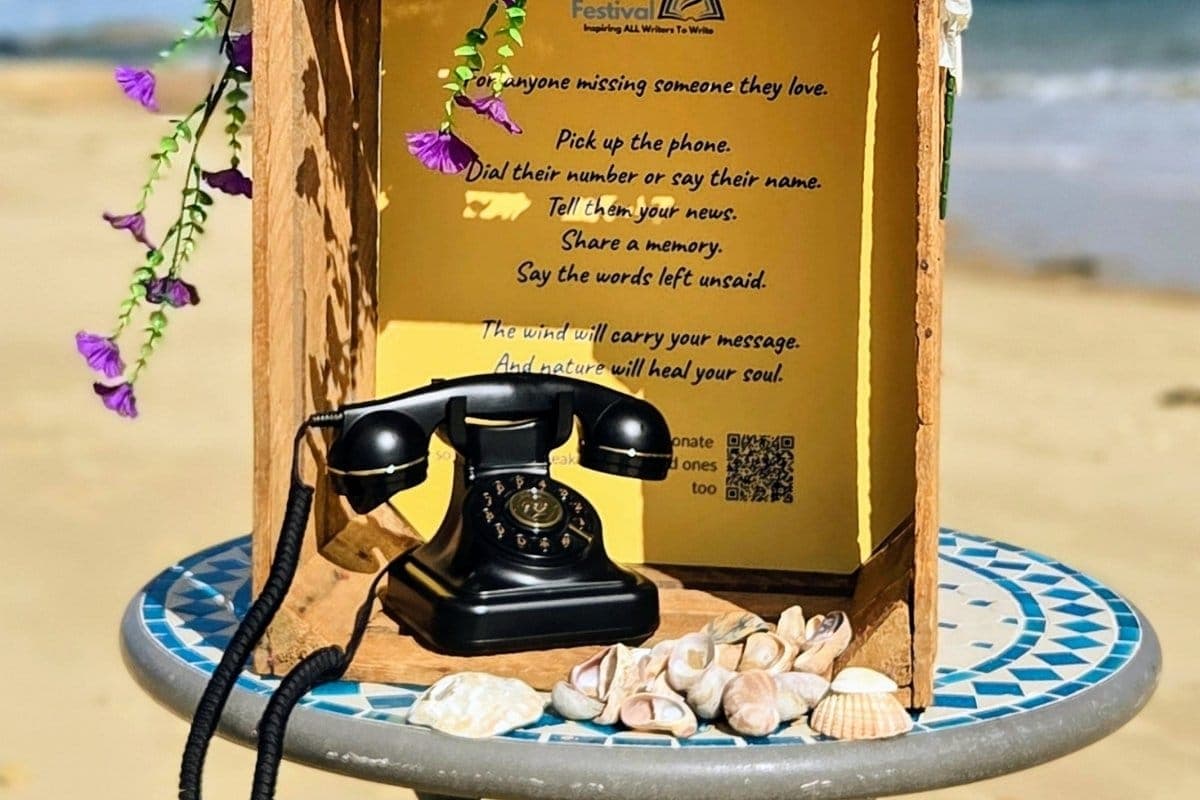
In a community café in Dorset, an old-fashioned red rotary dial phone sits in an upturned crate decorated with purple and white flowers, a yellow sign beckoning people to make a call.
And yet this phone isn’t plugged in. The call goes nowhere. The polka-dot windmill poking from the top of the crate offers a clue, as does the name etched on to the front: wind phone.
People can pick up the receiver, dial the number of someone they miss, and then let the wind carry their words.
This particular wind phone is a pop-up installation from the Bournemouth Writing Festival, which hosts an annual festival every spring and sprinkles the calendar with community outreach projects. Sitting at a café table near the wind phone, festival director Dominic Wong tells me the story of how this project came to be, describing how at a workshop for people with dementia he realised that people had amazing stories to tell but couldn’t necessarily get them down on paper.
He had heard about wind phones, created in Japan by garden designer Itaru Sasaki, who began to think about death as an extension of life. Itaru put an old telephone box in his garden in 2010, and used it to talk to his late cousin. A year later, a devastating tsunami killed thousands of people, and those who had lost loved ones used it to speak to people claimed by the disaster, their words meeting them on the wind.
Dominic and next-door neighbour Ania Kawka, who is a therapist and a Writing Festival volunteer, rummaged in their garages and charity shops to find materials for their wind phone.
They tell me how the phones can be used not only to talk to people who have passed away, but also people you’ve lost touch with.
“It’s so much easier to talk through the phone and express your feelings, and not directly look at the person,” Ania says.
The first outing for this pop-up wind phone was at the Bournemouth Writing Sanctuary, where writers come for a weekend to delve into creative projects. Wong brought the phone as a writing tool, so people could either use it for its original purpose, or talk to their characters to try out dialogue.
One member of the group picked up the phone and said: “Do you remember when we used to have a cup of tea? But now the saucer shakes.”
With their conversation over, receiver clicked back into the handset, they revealed that they were talking to someone who is still alive – someone who has dementia and Parkinson’s.
Wong’s own father died from dementia in October, and he and his family are planning a trip to China as a pilgrimage for him. Perhaps he’ll pick up the phone, he thinks, and tell his father about it.
The pop-up phone has travelled to cafés, the beach, and local festivals. Mere weeks after launching, they’re now speaking with care homes and businesses about installing bespoke wind phones for them, which would raise funds that go back into the Writing Festival.
Across the UK, there are currently 14 wind phones mapped on mywindphone.com, not including pop-ups like the Bournemouth Writing Festival’s.
They come in a variety of forms. At the Mary Stevens Hospice in Stourbridge, West Midlands, it’s in a summer house in the garden, styled in a nod to Sasaki, to thank him for his invention. Japanese-style tiles cover the roof, bamboo furniture offers somewhere to sit, and lights illuminate a tree in the evenings. The wind phone is there for anyone accessing bereavement support, or anyone in the local community who needs it.
“Grief is a very individual journey,” says Kerrie Jones, the hospice’s Bereavement Services Manager. “The phone offers people that opportunity to reflect, to reconnect with the deceased in private.”
The large space makes it accessible, and there’s a resource pack of referral forms and crisis numbers, which is there for anyone who needs it.
On the Isle of Portland, in Dorset, a phone box has found new life as a wind phone. This is part of “The Final Journey”, an artistic exploration of death and dying, with a group spearheaded by artist Antje Rook, who has a background in psychotherapy.
At the end of Rook’s road, there was an unused telephone box looking for a new purpose. This box, which came with a view of the sea, was to become the first wind phone in Dorset.

As they created the wind phone, a small group met to make clay tiles with sea life motifs, led by potter Stephen Yates; and someone else made a seat to go inside. Since then, they have had messages from people who’ve travelled a long way to use the phone, and others who’ve spoken to animal companions who have passed away.
Says Antje: “It provides an emotional release, because you can go there and call someone you have lost, you can express your emotions, and release feelings of whatever – anger, sadness, grief, guilt, regret.”
She describes death and dying as taboos in our culture, explaining how people are often encouraged to get over their grief quickly.
“There’s no time to stay with the grief and properly go through it, and I think the wind phone helps with that.”
Trying to move on quickly is something I’ve been guilty of myself. And so, after meeting Dominic and Ania from the Bournemouth Writing Festival, I sit down alone with their wind phone. My plan is to talk to my cat, Moomin, who I miss terribly. But I find I can’t. Anyone who’s lost a close animal companion will understand how deep this grief can run.
Instead, I pick up the phone to talk to my grandma. The last few years with her were shaped by dementia, and so a one-sided conversation doesn’t feel all that unusual. I tell her about my now six-year-old son, how much she’d love his cheeky personality, and about my recent travels all around Europe.
I’ve never liked grave visiting and so this feels a better fit for me. I feel a little self-conscious, yet warm. I imagine what she would say in between my words, and I’m thankful for that unconnected rotary phone, its upturned crate, and the little windmill that reminds me where my words will be taken.



Find a professional today
Try our guided search tool, we can connect you with over 20,000 professionals.