Meet Happiful Poetry Prize 2026 runner-up Minna Chang

updated on Jul 28, 2026
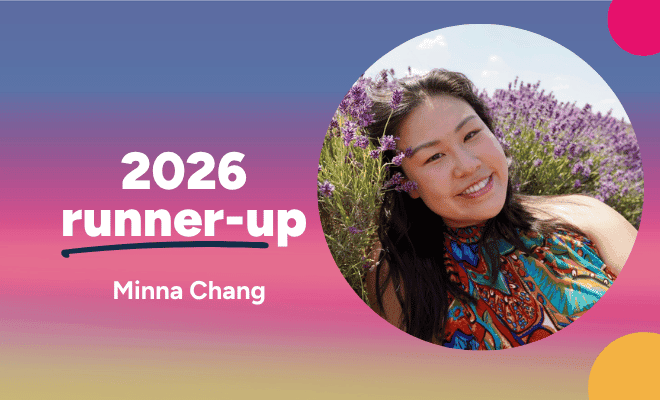
Runner-up Minna Chang's poem, I See You, draws on her experiences as a doctor to explore what it means to truly see another person.
Here, she shares how poetry became an unexpected part of her life, why honesty matters more than sounding "poetic", and the role writing plays in helping her process the emotional weight of medicine.
Feeling inspired? Learn more about the 2027 Poetry Prize which opens on 1 September, 2026.
How long have you been writing poetry? What does your writing life actually look like day to day?
I've always enjoyed playing with words. As a child, I liked to write little rhymes and silly verses, but I only consciously began experimenting with poetry last year.
Most of my day-to-day writing is actually very different. As a doctor and scientist, it's largely made up of academic papers, research, and clinical documentation.
I think that because of this, poetry has become a welcome and much-needed counterbalance. It lets me slow down, sit with emotion, and explore ideas that don't always fit into scientific language.
Do you consider yourself a poet first, or is poetry something you fit around other responsibilities?
I've never really thought of myself as a poet.
I think of poetry less as something that I am and more as something that occasionally finds me.
My work as a doctor and researcher naturally comes first, but poetry has a way of appearing in the subtle moments between everything else. It's less another responsibility to fit in and more a different language for making sense of the world when prose isn't quite enough.
Can you tell us about the process of writing your winning poem?
Yes, it grew out of experiences I've had as a doctor.
So much of medicine isn't just diagnosing illness – it's creating a space where someone can feel safe enough to lower the defences they've built over years, sometimes over their entire lifetime.
Patients often arrive wearing metaphorical masks, protecting themselves through fear, stoicism, or uncertainty. The poem imagines the quiet privilege of witnessing those masks slowly fall away.
Those moments of vulnerability allow us to understand the person behind the illness, to truly connect with them, and provide care that is holistic, personalised, and compassionate.
Did you experience any imposter syndrome around your poetry? What helped you submit it to the competition?
Absolutely!
I still struggle to believe that my work is sitting alongside the other incredible poets.
What helped me was focusing on writing something authentic and trying to let the work speak for itself. I had very few expectations, so I was incredibly grateful and surprised that it resonated with the judges.

What mistake do you see new poets making too often?
I think many new poets, myself included, worry a lot about sounding "poetic".
We naturally reach for perfection through complicated metaphors, elaborate rhythms and ornate words, when often the simplest, most honest line carries the greatest weight.
What role does poetry play in your wellbeing?
Medicine teaches us to carry a great deal, but we're not always trained in where, or how, to put it down.
Poetry and art have become that place for me. It's where experiences, emotions and questions can exist without needing to be solved or explained.
Writing doesn't necessarily make difficult things easier, but it makes them feel less lonely.
In many ways, poetry offers me the same gift I hope to offer my patients: a space to be seen without judgement.
Has writing helped you understand yourself differently?
Very much so.
I used to think writing was about expressing thoughts I already understood. I've realised it's often the other way around.
Sometimes I don't know what I really think or feel until I've written it.
Poetry has taught me to become more comfortable with uncertainty, vulnerability, and silence.
It has also reminded me that beneath our different stories, many of us are asking for the same thing: to be understood as we truly are.
What are a few tips you would give to someone getting started with writing poetry?
- Read widely and write often.
- Don't wait for inspiration to arrive with bells and confetti. It's often much quieter than we expect.
- Pay attention to ordinary moments. Some of the best poems begin with a glance across a room, a silence between sentences, or an everyday conversation.
- Stay curious a little longer than you normally would.
- Carry a notebook or use your phone to capture ideas as they come.
- Write the poem only you could write. Technique can be learned, but your voice, your experiences, and the particular way you notice the world are uniquely yours.



Find a professional today
Try our guided search tool, we can connect you with over 20,000 professionals.